Chattering

The End is Near…

of NaNoWriMo 2019, that is. I’ve been writing like a fiend all month and I am ALMOST THERE. So close to the 50K finish line. I’m hoping to win this Friday and as long as I don’t stumble, I’ll make it.

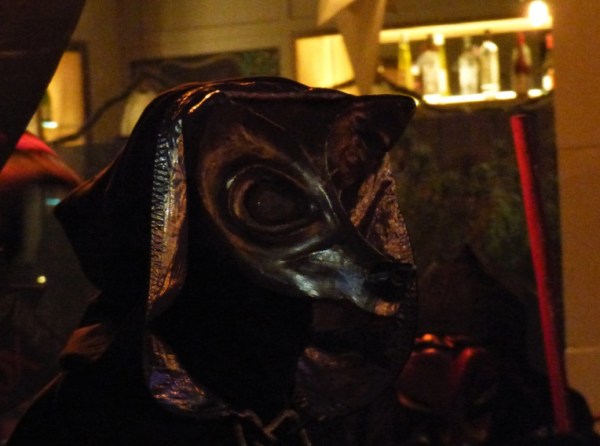
Vitruvian Mask Oct2019

I’m working on the sequel to The Archimedean Heart and despite plotting it to death, the characters have still managed to surprise me. Especially our protagonist, Adelaide Coumain, she who was once Royal Scientist-Physician, but has since come down in the world.

My plan is to finish the first draft by the end of December but we’ll see how THAT goes. After the intensity of NaNoWriMo (and ignoring the rest of my life) for a month, things do catch up with me in December.

The Pros and Cons of Prologues

Is “no prologue” one of those writing “rules” that don’t always make sense?

Do you think there are times you should write a prologue?

As a reader, do you read prologues?

M.L. Davis's avatarM.L. Davis Writer

Prologues can be a contentious issue. Everybody has a different opinion on them. I’ve known of readers who love them, agents who hate them, and everything in between! The last novel I wrote started with a prologue, even though as a reader I’m not a huge fan of them. Sometimes you just have to do what works for your novel. But for anyone who’s not sure, I’ve listed some of the pros and cons of prologues below.

The Pros:

You can hook the reader
Prologues tend to be short and sweet, and so it gives you the opportunity to really hook the reader with a gritty opening. You don’t need to introduce the characters involved in any depth, which gives you the chance to create a real air of mystery.

Chance to use a different POV
The prologue doesn’t have to follow the pattern of the rest of your story…

View original post 492 more words

Short: Dugong Dreaming

This sounds like a fun read: A short story about an opera singer stranded on one of Saturn’s moons, the tough choices of motherhood and some very musical Dugongs.
It’s nice to see some spec fiction from down under. I’m trying to read more world fiction. What’s your fave non-US/European novel?

shelcalopa's avatarShel Calopa

A short story about an opera singer stranded on one of Saturn’s moons, the tough choices of motherhood and some very musical Dugongs.

Available February 2020 in ASF’s Aquarius Anthology.

View original post

Prepping a sequel

Four years on, I am finally ready for a longer visit to my alt 1880s world of automatons and artists in Paris. I’m plotting the full sequel to The Archimedean Heart, my first full-length novel. This time, the protagonist is the roboticist Adelaide Coumain, although Henri will appear in an important role. No more hints!

I did write a short novella featuring Adelaide that was published in The Clockwork Oracle. That was set just after the events of Arch Heart. This new story will occur the following year. Much has happened in France when the book opens. Oh dear, I said no more hints, but there I go again.

I am planning on starting to write the book in November, during NaNoWriMo. Yep, I signed up for the madness once more. This means that to make my word count, I will be scribbling madly on the train to Reno when we go to the High Desert Steam Festival mid-November.

And since I generally struggle with titles, my dear daughter C came up with the perfect title:

The Vitruvian Mask

Vitruvian Mask Oct2019

I’ll talk about the meaning in another post.

Taste the Rainbow: Diversity, Inclusion, and the Outdoors Community

Something I wonder about a lot whenever I’m “out in nature.” Where ARE all the POC? As a kid who grew up in poverty, I get that’s a huge barrier for some

Aaron James's avatar

“National parks are the best idea we ever had. Absolutely American, absolutely democratic, they reflect us at our best rather than our worst.” Wallace Stegner said that, in 1983. That viewpoint, however, has come under ever greater scrutiny as we move into a century that will see a white minority by the year 2044 or 2045, according to U.S. Census data projections. The National Park Service has taken note of this and have consequently initiated outreach programs to minority groups in an effort to save their own lives. Why? Because outdoors spaces, national parks specifically, are and have been predominantly white, straight, cisgendered spaces. In recent decades this has become an unconscious trend, where minorities simply don’t see themselves reflected in the park advertisements or in park employment; on the other hand, this stems from a long history of racism that includes a park ranger telling Henry X. Finney…

View original post 1,903 more words

Should your protagonist be likable?

Evelyn M. Hill’s blog post struck home with me. While part of me resists the conventional wisdom that your protagonist be likeable (or at least respect-worthy), the fact remains that if you totally loathe a main character, it’s hard to want to keep reading. But some famous classics have awful protagonists and people read (and love) them.

So how do authors pull it off?

This is not a rhetorical question. The main character in my as-yet-unpublished novel Escaping Andronicus is decidedly unlikable. She detests her children and is having an affair with a married man. She’s a spoiled dilettante. She does find herself in jeopardy (one of the ways to make a character interesting), but not until midway into the book. But she gets better <insert obligatory Monty Pythonesque accent here>! She has a positive character arc. But it seems like I need to make her more sympathetic, or no-one will want to read the book. Or does she just need to be so compelling that readers love to hate her?

What would you do, dear readers? Re-write her to be more likeable or hold onto the initial character concept?

One flaw in many books is that even though the writing is good, the hero or heroine is a person that I would not want to spend five minutes with in real life. It’s rare for me to start a book and not finish it (DNF), but when I do that’s generally the reason. I’m […]

via Novel elements: characters you want to spend a whole book with — Evelyn M. Hill